Adjectives: Predicative 2 · 4200db9cfb3b915c71bb90aa13d440c6
Stop accusing me!
How do you know something is in the accusative case? Let’s review when we need this! You’ll need to use the accusative case when a noun is the target of someone’s action.
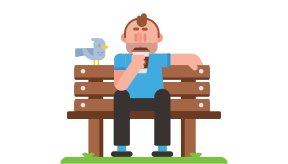 Er trinkt den Kaffee.
He drinks the coffee.
Things that follow words like durch, für, or ohne also use the accusative case.
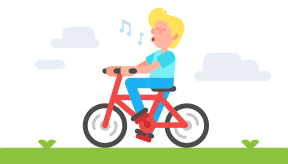 Er fährt durch den Park.
He rides through the park.
Finally, when something is moving somewhere, and you use a word like über, in, or zwischen, you’ll use the accusative case.
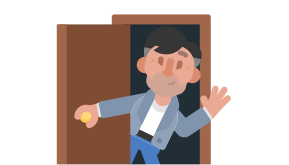 Er geht in den Raum.
He goes into the area.
| basic form | accusative form |
|---|---|
| der Mann mein Mann |
den Mann meinen Mann |
| die Frau meine Frau |
die Frau meine Frau |
| das Kind mein Kind |
das Kind mein Kind |
| die Kinder meine Kinder |
die Kinder meine Kinder |
German Sounds
Here are a few words that are difficult to say. Let’s practice them!
tatsächlichtatsächlich
(säch starts with z sound,
ends with harsh “humid” sound)
(säch starts with z sound,
ends with harsh “humid” sound)
Es ist egal!
Sometimes you don’t have an opinion. Sometimes you just don’t care. And sometimes you want to sing Bohemian Rhapsody at the top of your lungs in the shower — in German! For all of these situations, you’ll need the word egal!
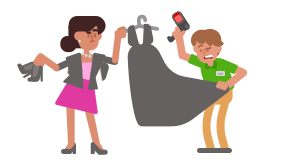 Egal, wie teuer es ist!
No matter how expensive it is!
 Alles ist egal!
Everything is insignificant!
(🎵 Nothing really matters! 🎵)